
Allow Me a Reframe?

A few weeks ago, the writer Tim Urban posed this thought experiment:
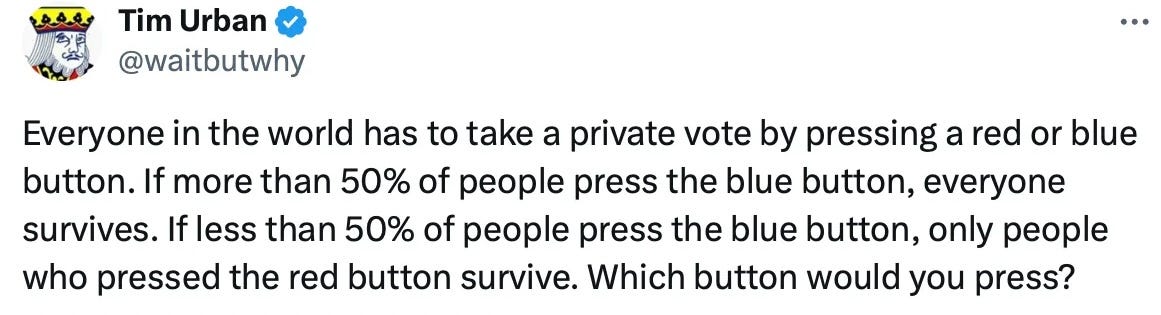
Much of the internet dropped what they were doing (i.e. reading the internet) to weigh in—and to fight.
Here in the U.S., the red-blue coding helped turn the discussion partisan, instantly: those who said red were deemed selfish Republican types, unable to see past their own interests. Those who chose blue were damned in turn: how idiotic, how illogical. Only dumb Democrat types would reject the most obvious answer (i.e. if everyone saves themselves, no one dies) in favor of something way riskier, something that depends on…mind reading?
Insulted, the blues shouted back at the reds: What about newborn babies? What about people in a coma? If they can’t press the red button for themselves, do you not care, you depraved monsters?
It went on and on and on.
Allow me a reframe (said the compulsive mediator, on a sure-fire path to alienating both sides):
This exercise revealed less about our values and more about different kinds of intelligence.
Extremists aside, I think most people value the same things: they care deeply about self-preservation and self-realization—but also about the greater good. We seem to understand on a cellular level that our survival, and especially our thriving, depend in large part on the survival and thriving of others. Again, there are extremists on both ends of the spectrum—a handful of sociopaths, a handful of martyrs—but most people are neither of these things. I believe the vast majority of humans aspire to live their best lives in the company of others who are doing the same.
This brings me to different kinds of intelligence. To have children (especially children navigating our current educational system) is to see our understanding of intelligence flattened—into standardized test scores, GPAs, and distinct tracks based on a very narrow definition of “capability.” To inhabit the broader world is (thank heavens) to glimpse human intelligence in all its glorious forms: dancers, scientists, cooks, surgeons, basketball players, painters, mathematicians, mechanics, engineers, builders, gardeners, therapists…the list is literally endless. Different minds, housed in different bodies, work in radically different ways. No stack ranking is required. No stack ranking makes sense. We benefit from, and should nurture, every form of human intelligence.
Back to the reds and the blues: I noticed—speaking offline to people I know well—that those who chose red tend to prioritize efficiency and logical consistency, and they are highly attuned to individual incentives. People who chose blue are more attuned to collective vulnerability and the slow work of community building. Neither orientation is wholly good or bad, and each serves a vital role. In my family, my business, and my civic life, I’d want the benefit of both. Wouldn’t you?
I love a good conundrum—but we should be careful to confine them to late nights in a dorm, long car rides, and convivial campfires. The internet wants us fighting; the real world demands that we link arms and work together.
If only the whole world were run by dogs.
It might obey commands, respond favorably to incentives, behave appropriately when admonished — everything would be sublime.
Instead, we’re surrounded by these unpredictable cat-spider-shark-vampires, who respond unpredictably, and refuse to behave.
If only the whole world were run by dogs.