
Note to Self: Go Play Outside

“Wanna climb a mountain tomorrow?”
Whenever I text this to my friend Ulla, she invariably says yes.
These outings are never easy to pull off. We’re both deep in what I call The Vortex—a seemingly endless swirl of tasks and commitments. But Ulla is half Swedish, and apparently that’s Swedish enough to require a yes to any outdoor adventure, no matter how inconvenient.
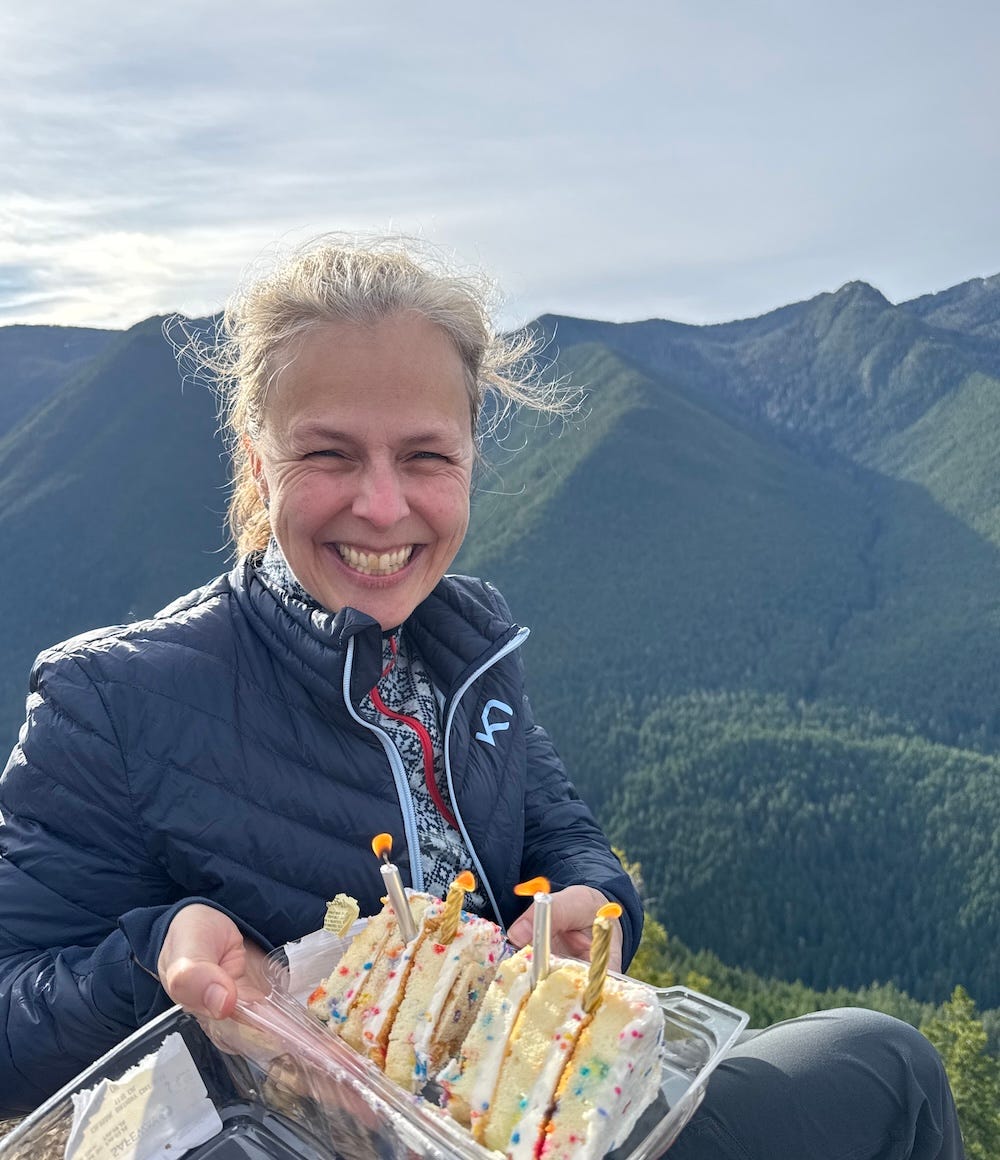
This photo—Ulla beaming because her birthday cake survived a backpack unscathed—is not from this week. It’s from earlier this month. We’d set out at 5 am, driven for 2.5 hours while the sun rose, scrambled up and down a steep peak, then made it home in time for dinner.
Leaving in the pitch dark with a car full of winter gear (ice axes, snow shoes, ski poles, micro spikes1) always makes us feel like we’re running away from home. Or at the very least: getting away with something. With a thermos of coffee and Ulla chatting away2, I briefly identify as a morning person on these trips. They are that exhilarating.
But again: that photo is not from this week. This week could not have been further from a mountain adventure with Ulla. It was sedentary, lonely, and deeply unsettling. It was the very opposite of cake.
It started on Sunday, when another AI memo went viral. This one, published by Citrini Research, was written in a particularly clever way: as a post from the future (June 2028) analyzing what went wrong in the economy starting in ::gulp:: 2026. One line in particular stopped me cold: “For the entirety of economic history, human intelligence has been the scarce input…we are now experiencing the unwind of that premium.”
The Citrini post has since been pooh-poohed by people who understand macroeconomics3 far better than I ever will—but it was well written enough to rattle investors on Monday, and I’d be lying if I said it didn’t rattle me as well. Surrounded as I am by scores of laid-off, white-collar workers (enterprise tech is still shedding employees at a brisk clip), the Citrini scenario played into all my enduring anxieties about mass job dislocation. I don’t think about AI as good or bad—this is a useless dichotomy that we should reject at every turn—but I do see AI as transformative at a speed that seems to far exceed society’s current ability to adapt.
Perhaps it was an own goal, similar to subjecting myself to the State of the Union4, to read such an alarming piece in the first place. But not reading these things that catch fire? That seems super head-in-sand.
So I wanted to ask: What about all of you? How do you decide what to take in and what to ignore? Related: how do you balance your time in front of a screen with your time spent roving the earth?
In winter, we take a lot of gear, so that we can pick a trail on the drive up. One of the keys, we’ve learned, is just to go. There’s almost always a trail to be found that’s both beautiful and navigable. Reading online trip reports in advance is essential—but only the most recent posts are truly helpful, and some serve (however inadvertently) to dissuade.
I am an introvert. Ulla is an extrovert. We have an understanding on these outings that Ulla can talk as much as she wants, and I can be as quiet as I want. I enjoy listening to her in the same way that I enjoy a good podcast.
If, after reading the Citrini piece, you also require a few well-crafted critiques to regain a sense of equilibrium, I recommend reading Noah Smith and the links he points to, as well as my thoughtful friend Steve Smith. (There’s also this blessedly short harumph from Jeremy Siegel—but if you didn’t already know that he’s Wharton’s most revered market whisperer, would this piece really quiet all the anxious voices in your head? With all due respect to Professor Siegel, I’m a hard no on that.)
If you didn’t watch the State of the Union yourself, 1) congratulations and 2) allow me to fill you in. Imagine a poorly-paced awards show. Now imagine the host of that show choosing to share horrific tales of true crime between awards. I believe it is 100% nonpartisan to observe that it was the weirdest SOTU ever. The only thing that got me through it was my parasocial relationship with The Bulwark’s head-in-hands Tim Miller.
After the 2024 election, I removed all social media apps from my phone, and I continue my post-2016 practice of not checking the news or social media during the workday. Of course, I am extremely privileged to even be able to consider tuning out the news, because that implies that most of it doesn't affect me directly. And the fascists *want* us to tune it out – whether that means shrugging because you actually don't care or withdrawing because you deeply care but feel powerless as an individual in the face of a deliberate campaign intended to overwhelm us with one chaotic or hateful thing after another.
As a Jew, I make every effort to live my life in accordance with tikkun olam (a responsibility to repair the world) balanced with "You are not obligated to complete the work, but neither are you free to desist from it" (Pirkei Avot 2:21). So, I decided to put a doom-scrolling surcharge on myself: When I get wound up by the latest news, I find organizations and/or individuals best-positioned to aid the most vulnerable, and I lend financial or other support. I turn my anger and outrage into "look for the helpers" action, so that even if I'm not on the frontlines, I'm doing *something* to make the world better.
1) I prioritize direct interaction with the world. 2) I delay engagement with the “hottest” stuff until it cools down … and that often means it just disappears. With the State of the Union, that meant I visited some friends and had a lovely dinner. 36 hours later I looked at a story or two about it; it appeared I didn’t miss anything important. The world will keep spinning without my attention, and I find I’m a lot happier when I’m not living inside the news.